How to tailor your resume for a specific job (without lying)
A concrete four-step framework for tailoring a resume to a job description - without keyword-stuffing, title inflation, or inventing skills you don't have.

To tailor your resume to a specific job, identify the posting's priorities, use its vocabulary where it truthfully describes your experience, move the most relevant evidence higher, and rewrite only a few bullets without changing the facts. Tailoring changes emphasis and wording, not your employers, skills, or results.
I spend most of my day reading resumes - alongside the job descriptions they're aimed at - and the overwhelming pattern is this: people either don't tailor at all (sending the same resume to seven companies in an afternoon) or they tailor too much, rewriting themselves into someone the interview will quickly unmask. Neither works.
What "tailoring" actually is
A tailored resume is the same life, re-weighted for a different reader. You're not inventing experience, you're choosing which true things to foreground. The seven roles you've held contain thousands of little stories; a tailored resume selects the dozen or so most relevant to this specific job, and tells them in language that the hiring manager will recognise.
Think of it like a documentary editor. Same footage. Different cut.
From the Boost My Resume internal style guideA tailored resume isn't a different resume. It's the same life, re-weighted for a different reader - and written in language that reader recognises.
A four-step framework
Every time I tailor a resume - for a friend, for a user we've sat down with, for myself - I do the same four things in the same order. Skipping any of them makes the result worse.
1. Read the job description twice. Once for skills, once for tone.
First pass: extract the must-haves. The hard skills, the tools, the years-of-experience requirement. Highlight every concrete noun. This is the easy part and it's the part most "tailoring" tools do for you.
Second pass is the one most people skip. Read the job description again and ask: what kind of person do they think they're hiring? Is the tone warm and scrappy ("you'll wear a lot of hats"), or precise and senior ("you'll own our multi-region deploy strategy")? That reveals more than the skill list. A "wear a lot of hats" job will not be impressed by a resume full of scope and scale; a senior infrastructure role will not be impressed by bullets about team culture.
2. Match their vocabulary, without parroting.
If the JD says "customer-facing," don't leave your resume saying "client-facing." If it says "experimentation," don't keep saying "A/B testing." These aren't keyword games - they're code words. Using the same vocabulary signals that you've read the thing, and that you already think in the team's terms.
But don't copy phrases verbatim. A hiring manager can spot a sentence lifted from their own job post from thirty feet away. Use their nouns; write your own verbs.
3. Reorder, don't rewrite.
The most under-used tool in tailoring is rank. You probably have ten bullets under your most recent role. Three of them are gold for this job; five are neutral; two are actively off-topic. Put the gold on top. That's often the entire tailor.
Same with sections. For a technical role, lead with the technical bullets. For a team-lead role, lead with the bullets about headcount, hiring, and performance management. The facts don't change; their order does.
4. Rewrite up to two bullets to be specific to this job.
The final move: pick your top two bullets and rewrite them to land exactly on what this job is asking for. Same underlying truth, sharper framing. One before/after is worth a thousand words of advice:
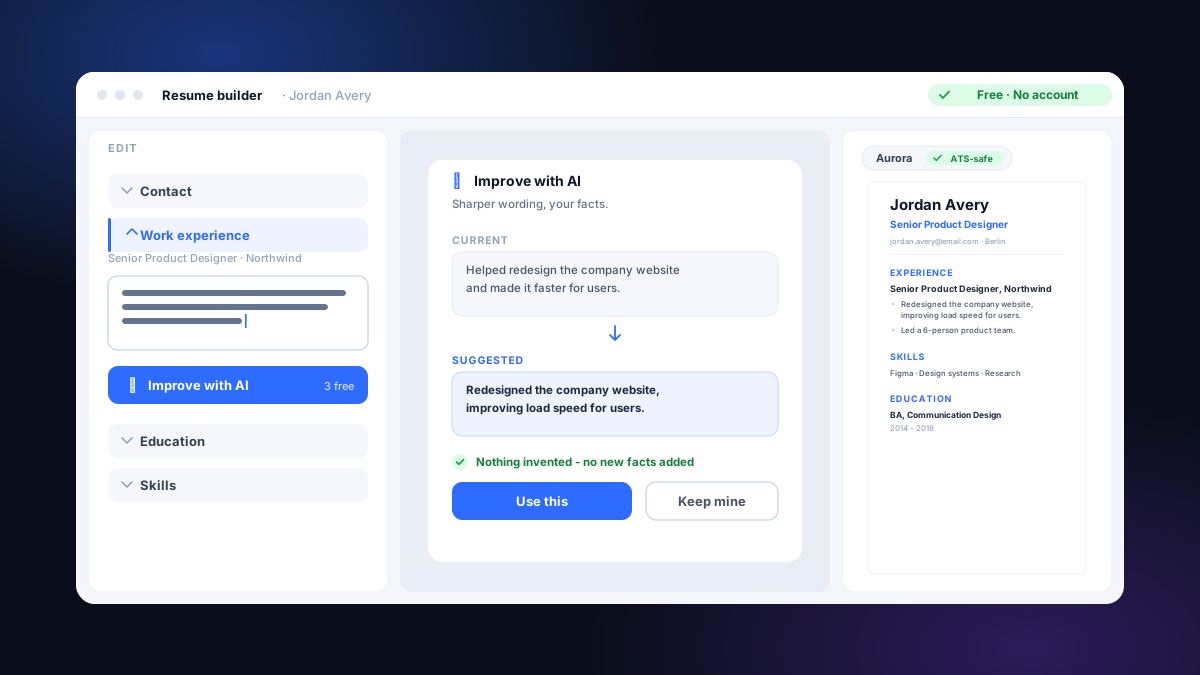
Same bullet. Same truth. But the "after" version uses the exact phrase from the JD ("new-user onboarding flow," "30-day retention"), swaps a vague outcome for a numbered one, and demonstrates comfort with scale. The hiring manager's eye stops.
Two more before & afters
Here are two more examples drawn from real tailoring sessions (anonymised, obviously). Notice that in both, nothing has been added - only rearranged and sharpened.
What not to do (a short list)
Because the pull toward overclaiming is so strong, here's the short list of things that will actively backfire. If you catch yourself doing any of them, stop.
- Do not add skills you don't have just because they're in the JD. The interview is thirty minutes away.
- Do not change your job titles. You can add a parenthetical ("Senior PM (Growth)") if it's honest. You cannot rename "Customer Support Associate" into "Customer Experience Manager" because the JD uses that phrasing.
- Do not invent metrics. "Improved performance by X%" is only credible if you can defend X under questioning.
- Do not copy sentences from the JD into your resume. Use their vocabulary, write your own sentences.
- Do not over-tailor past a certain point. If you're spending more than 25 minutes on a tailor, you're rewriting your life. Stop.
The pre-send checklist
Before you hit send, run through this. I wrote it on a Post-it above my monitor when I was job-hunting and it saved me from several applications that were clearly going to fail.
- Top-of-page summary mentions the role I'm applying for by title.
- My top three bullets would be relevant to this job even if everything below them were cut.
- I used the JD's vocabulary for at least one skill, one tool, and one outcome.
- Nothing in my Skills list is something I couldn't defend in a 15-minute conversation.
- Every number on the page is one I can explain the source of, on the spot.
- If I removed the company name at the top, the resume would still clearly be targeted at this role.
The goal of tailoring is not to maximise keyword overlap. The goal is to make a hiring manager, already twelve resumes into their afternoon, stop scrolling at yours and think "oh, this person has read the job." Nothing on this list is clever. All of it is work. If you do it for twenty minutes, you'll stand out against candidates who spent nineteen minutes cranking through their Easy Apply queue - which is, honestly, most of them.
Good luck out there.
Common questions
Isn't tailoring just keyword stuffing?
No. Keyword stuffing pastes a posting's terms onto your resume whether or not they're true. Tailoring re-weights what you genuinely did - leading with the experience that fits the role and using the words that team actually uses. Nothing gets invented.
How long should it take to tailor a resume for one job?
By hand, about 20 to 40 minutes once you have a framework: read the posting, pick the three things it really wants, and re-order your bullets to put those first. The four steps in this essay are meant to make that repeatable, not slower.
Will a recruiter notice a resume was tailored?
Only in the sense that it reads as a strong fit - which is the goal. Tailoring isn't a trick to hide; it's the difference between a generic resume and one written in the role's language. What you don't want them to notice is inflation, which is exactly what the 'without lying' part rules out.