Language Proficiency on a Resume: Levels and Examples
Describe language proficiency on your resume with a recognized scale, specific work use, and verifiable evidence instead of vague labels or stars.
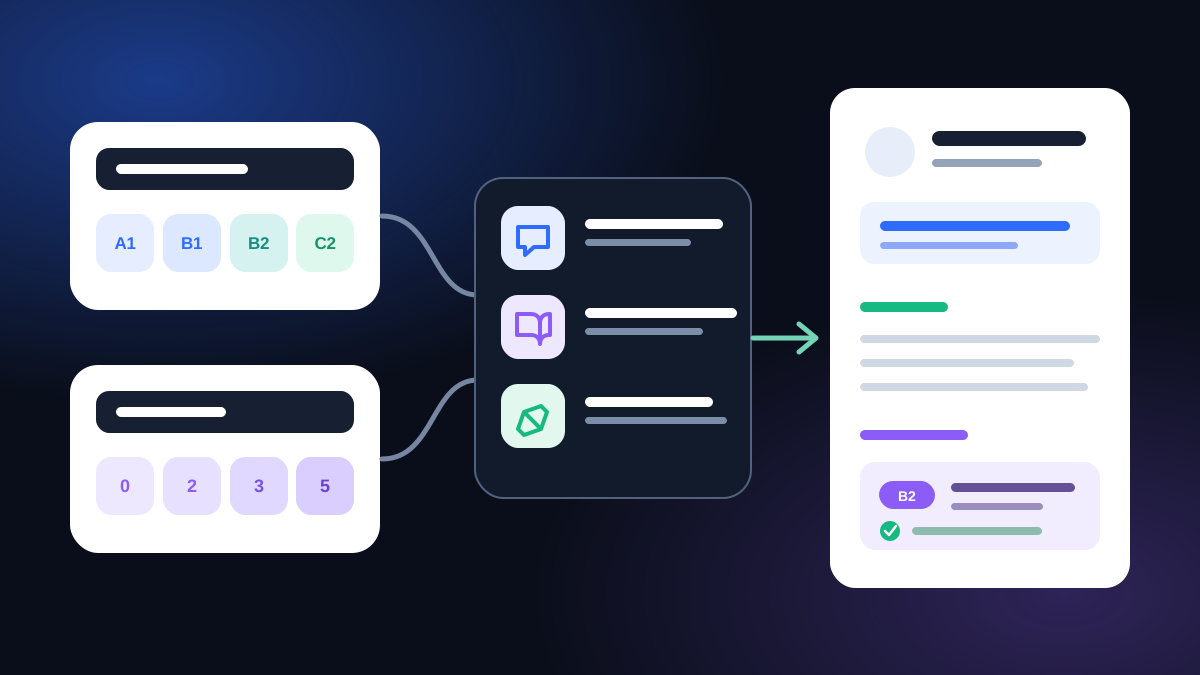
List language proficiency on your resume as language + named level or scale + relevant use or credential. Example: Spanish - CEFR B2 - weekly client calls and product documentation. Use the framework requested by the employer when one is named. Avoid unlabeled stars, progress bars, and vague terms that do not explain what you can do.
Your language section should answer a practical question: can you speak, read, or write at the level this job requires? A recognized scale reduces ambiguity; a work example makes the claim easier to understand and verify.
Language proficiency resume examples
| Resume wording | Verdict | Why |
|---|---|---|
| Spanish ★★★★☆ | Avoid | The scale and assessed skills are unknown |
| Fluent Spanish | Ambiguous alone | “Fluent” can mean different things in different jobs |
| Spanish - CEFR B2 | Clear | The claim names a shared framework |
| Spanish - CEFR B2 - weekly client calls and documentation | More useful | The level is connected to real work |
| Mandarin - ILR speaking 3, reading 2 | Precise | The framework and separate skills are explicit |
| French - DELF B2, 2025 | Verifiable | The credential, result, and year are named |
The best wording depends on the work. A customer-service role may prioritize spoken interaction. A research or compliance role may need high reading and writing proficiency. State the skill the employer will actually use.
Which language proficiency scale should you use?
Use the scale named in the job posting, application, public program, or credential. If no framework is requested, choose one that your intended reader is likely to understand and label it clearly.
CEFR: A1 to C2
The Common European Framework of Reference for Languages, or CEFR, uses six levels:
| CEFR level | Broad category | Functional resume summary |
|---|---|---|
| A1 | Basic user | Very simple exchanges in familiar, predictable situations |
| A2 | Basic user | Simple communication for routine tasks and immediate needs |
| B1 | Independent user | Independent communication on familiar topics and common work situations |
| B2 | Independent user | Clear, reasonably spontaneous communication, including familiar technical topics |
| C1 | Proficient user | Flexible, effective language use in demanding professional or academic settings |
| C2 | Proficient user | Very broad, precise, and nuanced comprehension and expression in complex settings |
The Council of Europe CEFR self-assessment grid covers listening, reading, spoken interaction, spoken production, and writing. Use its actual descriptors before choosing a level; the summaries above are only orientation for resume writing.
ILR: 0 to 5
The U.S. government's Interagency Language Roundtable scale uses base levels from 0 to 5, with plus levels between them. The U.S. Department of State's language definitions describe speaking and reading separately.
| ILR level | Official short label | Functional resume summary |
|---|---|---|
| 0 | No practical proficiency | No functional ability for the relevant skill |
| 1 | Elementary proficiency | Routine travel, courtesy, or very basic reading needs |
| 2 | Limited working proficiency | Routine social demands and limited work requirements |
| 3 | Minimum professional proficiency | Effective participation in most practical, social, and professional discussions, or comparable reading ability |
| 4 | Full professional proficiency | Fluent and accurate use across professional needs |
| 5 | Native or bilingual proficiency | Functionally comparable to an educated native user on the assessed skill |
Do not write “ILR 3” after taking an unrelated online quiz. A self-estimate should be identified as such. An official tested rating should be named with the testing context when relevant.
Do not guess a CEFR-to-ILR conversion
CEFR and ILR organize skills differently and are used in different contexts. A simple chart found online does not make two levels equivalent. If your credential reports CEFR B2, write CEFR B2. If a U.S. government test reports speaking 3 and reading 2, write those ILR results. Convert only when the issuing body provides an official crosswalk that applies to your result.
Assess speaking, reading, and writing separately
Language ability is not one uniform score. Europass's official self-assessment guidance asks users to compare listening, reading, spoken interaction, spoken production, and writing with CEFR descriptions.
The U.S. Department of State similarly reports speaking and reading independently. Its official guidance gives examples such as separate S and R ratings rather than assuming both skills match.
This matters because you may be able to:
- read technical documentation but not lead a fast negotiation;
- speak comfortably with customers but write only simple messages;
- follow meetings but need review on formal reports;
- write academic material but lack spontaneous spoken interaction.
If the skills are close and language is secondary, one level can be enough. If the difference affects the role, be explicit:
German - CEFR B2 speaking and reading, B1 writing - monthly supplier meetings.
or
Arabic - self-assessed ILR speaking 2, reading 1.
Do not present five sub-scores when the detail adds no value. Precision should make the section easier to use, not harder to scan.
How to choose an honest level
1. Read the official descriptors
Start with the framework's own descriptions. Read the level you think fits and the one below it. Select the level whose activities you can perform consistently, not the one you can reach once with extensive preparation.
The ILR's government self-assessment materials explicitly distinguish a rough self-estimate from an official government test. They also instruct users to answer no when they can perform a described task only some of the time or only in some contexts. That is a useful standard for any honest self-assessment.
2. Test the claim against real work
Ask questions tied to the target role:
- Can I follow a normal meeting without continuous translation?
- Can I explain a problem, answer follow-up questions, and resolve a misunderstanding?
- Can I read the documents this role uses?
- Can I write the expected email, report, or technical note?
- Can I maintain that performance under ordinary work pressure?
Daily conversation does not automatically prove legal, medical, scientific, or technical proficiency. Name the context you actually know.
3. Find one useful piece of evidence
Evidence might include:
- weekly meetings with an international team;
- customer calls or in-person support;
- reports, procedures, or documentation you wrote;
- study or professional work completed in the language;
- translation or interpreting, if that was truly your role;
- a named test or certificate.
Keep the resume line short. Put detailed evidence under the job or project where it happened.
4. Prepare for verification
An interviewer may switch languages or ask you to discuss the work example. Review your professional vocabulary and be ready to explain the context you named. Raising the level to match a job requirement can create an immediate credibility problem.
Fluent, professional, bilingual, or native?
Fluent
“Fluent” is understandable but undefined. Pair it with a framework and context when accuracy matters:
Italian - CEFR B2, used regularly with suppliers.
This is more informative than “fluent Italian” alone.
Professional working proficiency
This phrase has a specific relationship to the ILR scale in U.S. government settings. If you use an ILR label, include the scale and skill: ILR speaking 3, not a detached phrase that looks official without a tested or carefully self-assessed level.
In a general commercial resume, you can describe professional use plainly:
Portuguese - professional use in weekly sales calls and written proposals.
Add a recognized level when you can assess it responsibly.
Bilingual or native
Reserve “bilingual” or “native” for a background and functional level that genuinely support the claim. Advanced study does not automatically make someone bilingual, and identity alone does not describe every professional skill. The ILR Testing Committee notes that its scale describes functional ability, not identity, and that native speakers can have different proficiency levels.
How to list a language test or certificate
Include:
- language;
- official test or certificate name;
- reported level or score;
- year, plus a validity date if one matters.
Examples of structure:
French - DELF B2, 2025.
Mandarin - ILR speaking 3 / reading 2, tested by [authorized body], 2026.
Spanish - [official test name], [score], 2025.
Do not rename a certificate, round a score, or convert it to a different framework without an official basis. An older result can remain evidence of achievement, but it may not prove your current working level. Add recent use when the language is central to the job.
Language proficiency examples to adapt
Replace bracketed details with your own facts. Do not copy a level or activity that is not yours.
Regular professional use
Spanish - CEFR B2 - weekly client calls and product documentation.
Different skill levels
Mandarin - ILR speaking 3, reading 2 - quarterly presentations and routine correspondence.
Certified level
French - DELF B2, 2025 - university study completed in French.
Limited but relevant use
Dutch - CEFR A2 - greetings and routine visitor requests.
Native language plus professional second language
Arabic - native language; English - CEFR C1, daily professional use.
Level in progress
German - current CEFR B1 - enrolled in a B2 course, exam planned for [month year].
Your current level remains B1 until your demonstrated ability or assessment supports B2. “B2 in progress” should describe real preparation, not the level you hope the reader assumes.
Where should languages go on a resume?
Use a separate Languages section when proficiency is required, relevant, or differentiating. Place it:
- near Skills when several languages matter;
- higher when a language is an essential job criterion;
- lower when it is supplementary;
- inside an experience bullet too when a specific result occurred in that language.
Avoid flags as the only labels. A language belongs to more than one country, and a flag communicates no level. Use explicit text that remains understandable and accessible.
Tailor the section without inflating it
You can reorder languages and emphasize the skill most relevant to the vacancy. You cannot upgrade the level to satisfy the requirement.
| The job requests | Your evidence | Honest response |
|---|---|---|
| Spanish CEFR C1 | Certified B2 with weekly use | List B2 and the use; do not write C1 |
| Professional Mandarin | ILR speaking 3, reading 2 | List the skills separately |
| French preferred | Current A2 | Include A2 only if it adds useful information |
| German required | No functional level | Do not add the language; reconsider fit or explain a real learning plan outside the claim |
Language proficiency checklist
- I used the framework requested by the employer when one was named.
- Stars and bars were replaced by explicit text.
- The framework is labeled, such as CEFR or ILR.
- Material differences between speaking, reading, and writing are clear.
- The work example is real and relevant.
- Every credential has its exact name, result, and year.
- A self-assessment is not presented as an official test score.
- I can perform at the stated level in an interview or work sample.
Government and intergovernmental sources
- Council of Europe - CEFR self-assessment grids
- Europass - How to self-assess your language skills
- U.S. Department of State - Language proficiency definitions
- Interagency Language Roundtable - Self-assessment of reading proficiency
The right language level is not the most impressive label. It is the clearest supported description of what you can do. Name the framework, show the relevant skill, and give the reader evidence they can verify.
Common questions
How should I list language proficiency on a resume?
List the language, a named level or recognized scale, and one relevant use or credential. For example: Spanish - CEFR B2 - weekly client calls and product documentation. Use the employer's required framework when one is specified.
What are the levels of language proficiency for a resume?
Two official frameworks are CEFR, which uses A1 through C2, and the U.S. government ILR scale, which uses 0 through 5 with plus levels. Do not convert between them by guesswork. Name the framework and assess the relevant skills separately.
Should I write fluent, bilingual, or native on my resume?
A label such as fluent is clearer when paired with a recognized level and work example. Reserve bilingual or native for a level and background that genuinely support the claim; do not use those words as upgrades for advanced study alone.
Can speaking and writing have different language levels?
Yes. Official frameworks distinguish skills, and an employer may care about one more than another. If the difference is material, list it directly, such as ILR speaking 3 and reading 2, or CEFR B2 speaking and B1 writing.
Should I put a language certificate on my resume?
Include it when it is relevant, requested, or useful evidence. Give the official name, result, and year, and note any validity period that matters. Do not present a self-assessed CEFR or ILR level as a tested credential.