Luxembourg CV format: rules for a trilingual job market
French, German, Luxembourgish - and English in finance and tech: the Luxembourg CV format for English speakers, from photo habits to the languages section.
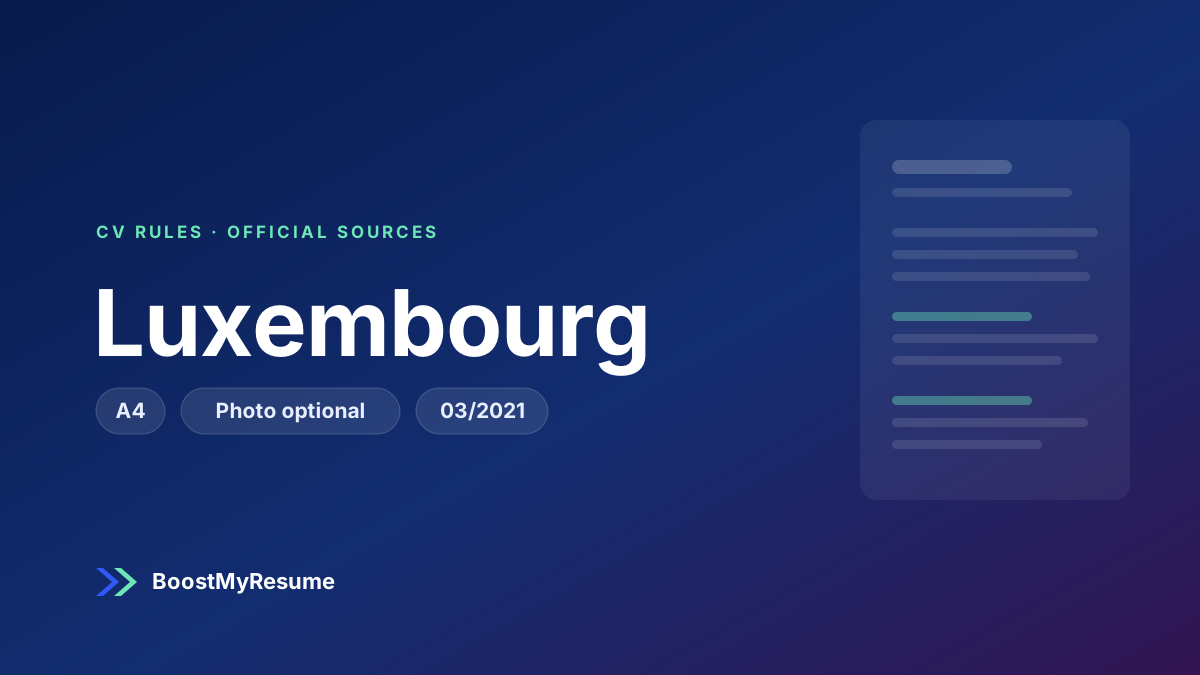
The Luxembourg CV format uses one to two A4 pages, matches the language of the vacancy, and gives the languages section unusual weight. Hiring runs trilingual, in French, German and Luxembourgish, with English as a genuine fourth working language in finance and tech. A photo is common but optional, and a cover letter normally forms part of the application package. This guide covers the details; the wider picture across eleven markets is in our resume format by country guide.
The rules in brief
- Language: match the vacancy; French is the most frequent default, English common in finance and tech.
- Photo: common, not mandatory - your call, guided by the employer.
- Date of birth, age: omit.
- Length: 1–2 pages.
- Page size: A4.
- Dates: day-first -
03/2021 – 06/2024on the CV. - Cover letter: normally part of the application package.
- File:
Jordan_Avery_CV_LU_FR.pdf.
Which language, for which CV
The rule is the same as in neighbouring Belgium: the vacancy's language decides. In practice:
- French is the most frequent default across the market - banking, services, public-facing roles.
- German appears in postings from firms oriented toward the German-speaking market and in some media and administrative contexts.
- Lëtzebuergesch matters most in the public sector and citizen-facing roles.
- English is a first-class application language in finance, fund administration and tech, where entire teams work in it daily.
For an English speaker this is one of continental Europe's most accessible markets: an English CV is genuinely viable wherever the posting is in English, which in the financial centre is often. But viable is not universal - a French-language posting still expects a French CV, and answering it in English signals that the day-one working language would be a problem. When you do write in French or German, keep European conventions: A4, day-first dates, and headings from the tables below.
The languages section: your most-read lines
Whatever language the CV is in, its languages section will be read closely. Luxembourg's workplaces are multilingual as a matter of routine - a meeting can open in French and close in English - so recruiters screen for language combinations the way other markets screen for tools. Three habits pay off:
- List every language you work in, including your native one, with an honest CEFR level for each.
- Do not round up. Declared levels get tested in the first call, and an inflated B2 costs more than a truthful B1.
- If you are learning Luxembourgish or French, say so with the current level - in this market, visible progress in a local language is a real signal.
Photo and personal data
A professional photo is still common on Luxembourg CVs, but it is a habit, not a requirement - and a photo-free CV loses nothing with an ATS. Let the employer and the sector guide the call: a traditional local firm sits closer to the photo convention, an international fund administrator does not care. Date of birth and the rest of the personal block are better left off; data minimisation is the safe default across the EU, and nothing in Luxembourg screening needs your age or marital status. City and country are enough for location - and for the many cross-border commuters applying from France, Belgium or Germany, a clearly stated location answers the feasibility question up front.
Structure and section headings
The skeleton is the standard reverse-chronological one: contact details, a short profile, work experience, education, skills, languages, and further sections only where they earn their space. The headings in the three national application languages:
| Language | Standard headings |
|---|---|
| Français | Coordonnées · Profil professionnel · Expérience professionnelle · Formation · Compétences · Langues · Certifications · Références |
| Deutsch | Kontaktdaten · Profil · Berufserfahrung · Ausbildung · Fähigkeiten · Sprachen · Zertifikate · Referenzen |
| Lëtzebuergesch | Kontaktdaten · Beruffsprofil · Beruffserfarung · Ausbildung · Kompetenzen · Sproochen · Zertifikater · Referenzen |
Length, page, dates and the file name
One to two A4 pages. Luxembourg prints on A4; a US Letter export reformats the moment it meets a local printer and marks the document as prepared elsewhere.
Dates, day-first. Luxembourg numeric order is day-first - 14/03/2026. On the CV, use month-year numerics such as 03/2021 – 06/2024, or spelled-out months in the language of the document, and never US month-first numbers. Translate the current-role word into the CV's language: aujourd'hui in French, heute in German.
File name. Jordan_Avery_CV_LU_FR.pdf - or _LU_EN.pdf for an English application. ASCII characters and underscores.
Cover letter and application package
A cover letter is normally part of the Luxembourg application package, written in the same language as the CV. Keep it short and specific - the company, the role, the two or three reasons the match works, and for cross-border applicants a plain sentence on location and availability. The frame in our cover letter structure guide applies unchanged. Certificates and diplomas are not attached unless requested.
ATS notes for the Luxembourg market
Luxembourg's larger employers - banks, Big Four firms, EU institutions - screen at volume, so the machine-readability baseline applies in full:
- One text column, standard headings from the table above, normal reading order.
- Name, phone, email, city and links in the document body, not only in a header or footer.
- Selectable text; no scanned pages, no skill-rating graphics, no tables as layout.
- A text-based PDF unless the portal asks for DOCX.
- One date convention throughout.
The full mechanics are in our ATS optimization guide.
Luxembourg quirks worth knowing
- The market is smaller than its neighbours and more international than either. A large share of the workforce commutes across a border every day, and applications from Metz, Arlon or Trier are entirely normal.
- Finance and tech run in English. Whole hiring pipelines operate in English in the financial centre - the clearest case in continental Europe where an English CV is simply the right document.
- The neighbouring markets differ. A CV built for Luxembourg travels well to Belgium, but check the language map before reusing it there - and Germany adds its own package conventions.
- Nothing is legally mandated. No template is required for private-sector applications; the vacancy and the employer's instructions always override the default.
Sources
Common questions
What language should a CV for Luxembourg be in?
Match the vacancy. Luxembourg hiring runs trilingual - French, German and Luxembourgish - with French as the most frequent default, and English common in finance and tech. The language of the job posting tells you the language of the CV.
Can I apply in Luxembourg with an English CV?
Often, yes. English is a genuine working language in Luxembourg's finance and tech sectors, and vacancies posted in English can be answered in English. For French- or German-language postings, write the CV in that language.
Do I need a photo on a Luxembourg CV?
It is common but not mandatory. A professional photo is still a habit on Luxembourg CVs, but a photo-free CV loses nothing with an ATS. Let the employer and the sector guide the call.
How long should a Luxembourg CV be?
One to two A4 pages, with a cover letter normally part of the application package.
How should I list languages on a Luxembourg CV?
Every language you work in, with honest levels. Listing your languages accurately matters more in Luxembourg than almost anywhere else - multilingual daily work is the norm, and declared levels get tested early.