US resume format: the rules of the American resume
Photo, page size, dates, length and personal data on a US resume: what American employers expect, why anti-discrimination law shapes it, and how to comply.
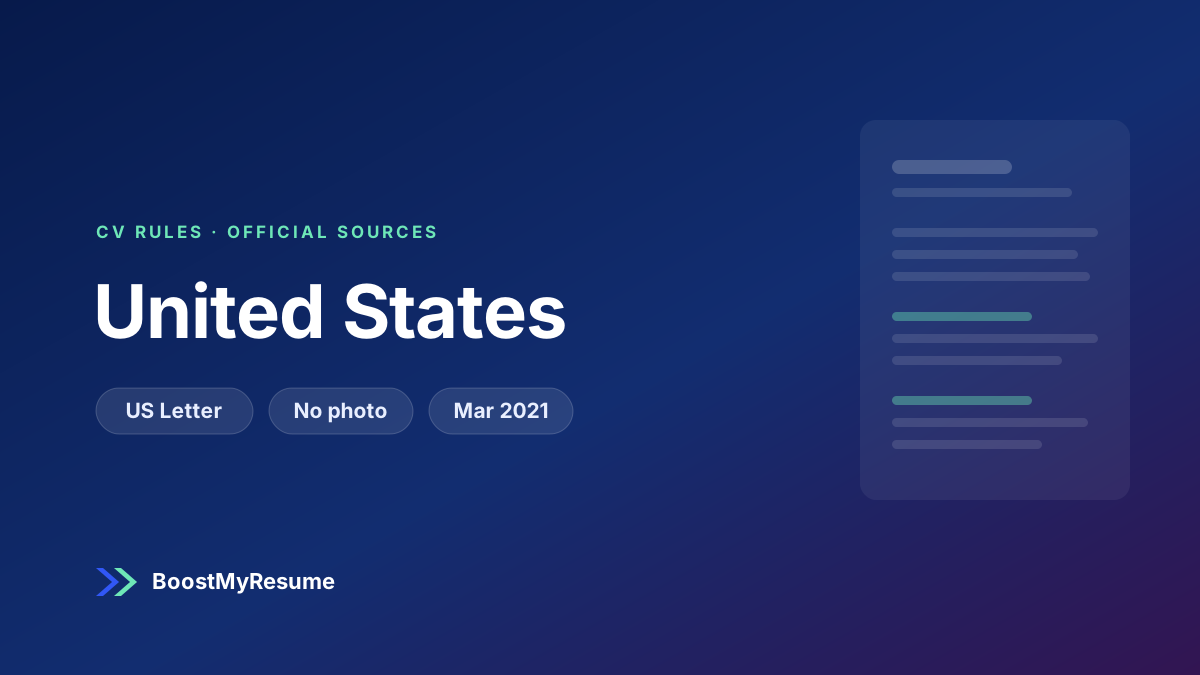
The American resume is the most stripped-down application document in our country-by-country format guide: no photo, no date of birth, no nationality, no marital status, city and state instead of a street address. That minimalism is not a style preference - it comes from how US anti-discrimination law works, and understanding the mechanism makes every rule below easy to remember.
The rules in brief
- Photo: never.
- Date of birth, age, nationality, marital status: omit by default in ordinary applications.
- Address: city and state only - no street address.
- Length: 1–2 pages.
- Page size: US Letter, not A4.
- Dates:
Mar 2021 – Present; never all-numeric day dates. - Wording: it is a resume - "CV" means a long academic document here.
- References: a separate document, provided on request.
Why the US resume carries so little personal data
Most countries treat personal data on a CV as a matter of custom. In the US it is a matter of the employer's legal exposure. Federal law - enforced by the Equal Employment Opportunity Commission - prohibits employment discrimination based on protected characteristics, and that prohibition binds the employer's side of the table. Nothing stops you from writing your age on a resume; the problem is that recruiters do not want information about protected characteristics in front of them when they make a screening decision, because it exposes their process. Many will discard a resume that carries a photo or a birth date rather than handle it.
So the safe posture is simple: give the reader nothing to filter you by except your work.
- No photo. Not optional, not "depends on the industry" - off.
- No date of birth or age. Same logic. Graduation years already hint at age; you do not need to spell it out.
- No nationality or marital status. If the role has a work-authorization question, the application form will ask it directly.
- City and state, not a street address. The Department of Labor's CareerOneStop guidance recommends leaving the full street address off;
Austin, TXdoes everything a recruiter needs.
If you are arriving from a market where the photo and personal block are traditional - Switzerland, Germany, Austria - this is the single biggest change to make, and it is not negotiable.
Nationality: your choice
Our default for ordinary US applications is to omit nationality. The EEOC distinguishes citizenship questions from verification of employment eligibility; it does not impose a blanket ban on applicants mentioning citizenship. Follow any specific, applicable eligibility instructions separately.
In the editor, nationality is optional in every document language. A supplied value, including dual nationality, stays saved; you choose whether it appears on the CV. Hiding it does not erase it, and changing language or target market does not change that choice. Nationality, country of residence and work authorisation are separate facts.
Resume, not CV
In American usage the two words name two different documents. A resume is the short, targeted, one-to-two-page summary employers expect for almost every job. A CV - curriculum vitae - is the long academic document: publications, research, teaching, conference talks, running to many pages. Send a CV to a company recruiter and, at best, it reads as too long; call your resume a CV in your file name or cover email and it reads as imported.
One small typographic note: the Department of Labor itself writes résumé with accents. Either spelling - resume or résumé - is fine; pick one and keep it consistent.
Structure and section headings
The standard American structure is contact details at the top, a short professional summary, then experience in reverse-chronological order, education, skills, and whatever else earns its space. These are the headings an American recruiter - and an American ATS - expects to find:
| Language | Standard headings |
|---|---|
| English | Contact details · Professional summary · Work experience · Education · Skills · Languages · Certifications · References |
| Español | Datos de contacto · Perfil profesional · Experiencia profesional · Formación · Habilidades · Idiomas · Certificaciones · Referencias |
Why the Spanish row? Because Spanish-language vacancies exist in the US market, and they follow American document rules: Letter paper, no photo, no personal data, same structure. Only the language of the content changes. A Spanish-language resume for a Miami employer is an American resume in Spanish, not a Spanish CV.
Length, page size, dates and the file name
Length. One to two pages. One page is the norm early in a career; two pages are fine when the experience genuinely fills them.
Page size. US Letter (8.5 × 11 in), not A4. An A4 export will not get you rejected, but it reformats margins and page breaks the moment anyone prints it, and it signals a document prepared for another market. In our builder the page size is a one-click setting under Customize - switch the export to Letter there.
Dates. Spell the month: Mar 2021 – Present. The reason is the classic transatlantic trap - the US writes all-numeric dates month-first, so 03/04/2025 means March 4 to an American reader and April 3 to almost everyone else. Month names make the string unambiguous in both directions. Keep one date convention throughout the document, on the same line as each role.
File name. Clear ASCII, no spaces: Jordan_Avery_Resume_US_EN.pdf. Note the word Resume in the file name - not CV - and for a Spanish-language vacancy, Jordan_Avery_Resume_US_ES.pdf.
Cover letter and references
References live in a separate document, provided when the employer asks. The old closing line "References available upon request" wastes a line - every recruiter already assumes it. Keep the resume's References heading for the rare case where a posting explicitly wants referees listed; otherwise drop the section entirely.
Cover letters follow the posting. When a vacancy or application form asks for one, send one, tailored to the role; when it does not, the resume carries the application on its own. The employer's instructions always override the default.
ATS notes for the US market
The US is the most ATS-saturated hiring market in the world, so machine readability matters at least as much as convention:
- One text column, normal reading order, the standard headings above.
- Name, phone, email, city and links in the document body - not only in a header, footer or text box, which some parsers skip.
- Selectable text, no scanned pages, no skill-rating charts, no tables for the main layout.
- A text-based PDF unless the portal explicitly asks for DOCX.
The mechanics - and the traps that silently blank out a parsed resume - are covered in our ATS optimization guide.
American quirks worth knowing
- Month-first numbers are the local convention. If you must write a fully numeric date on a form, the US order is month/day/year -
03/14/2026. On the resume itself, avoid the format entirely. - Spanish-language vacancies keep every American rule. Language changes; Letter paper, no photo and no personal data do not.
- Graduation years are the one date you may consider trimming. They are conventional to include, but they are also the main age signal left on a data-minimized resume; treat them deliberately.
- The rest of North America is close, not identical. Canada shares the Letter page, the missing photo and the omitted birth date, but adds bilingual rules and its own date recommendation - see our Canadian resume format guide before reusing a US resume north of the border.
Sources
- CareerOneStop - Résumé formats (U.S. Department of Labor)
- CareerOneStop - Top portion of a résumé (U.S. Department of Labor)
- EEOC - Prohibited employment practices
Common questions
Do I need a photo on a US resume?
No. US resumes never carry a photo. Federal anti-discrimination law binds the employer's side - recruiters do not want information about protected characteristics in front of them, and many will discard a resume that carries a photo rather than handle it.
Is A4 paper okay for a US resume?
Use US Letter, not A4. An A4 file will not reject your application by itself, but it reformats margins and page breaks when printed, and it quietly signals a document prepared for another market. Export for Letter when applying in the US.
How long should a US resume be?
One to two pages. One page is the norm early in a career; two pages are fine when the experience genuinely fills them. Anything longer belongs in an academic CV, which is a different document.
What is the difference between a resume and a CV in the US?
In American usage a resume is the short one-to-two-page document employers expect, while a CV is a long academic document covering publications, research and teaching. Send a resume unless you are applying in academia.
Should I put my full address on a US resume?
No. The Department of Labor's CareerOneStop guidance recommends leaving off the full street address - city and state are enough.
What date format should a US resume use?
Spell the month, as in Mar 2021 – Present. All-numeric day dates are ambiguous across the Atlantic - 03/04/2025 reads as March 4 in the US and April 3 almost everywhere else.