Canadian resume format: rules for English and French Canada
US Letter, no photo, never your SIN, and dates that read differently in English and French: the Canadian resume format, from Government of Canada guidance.
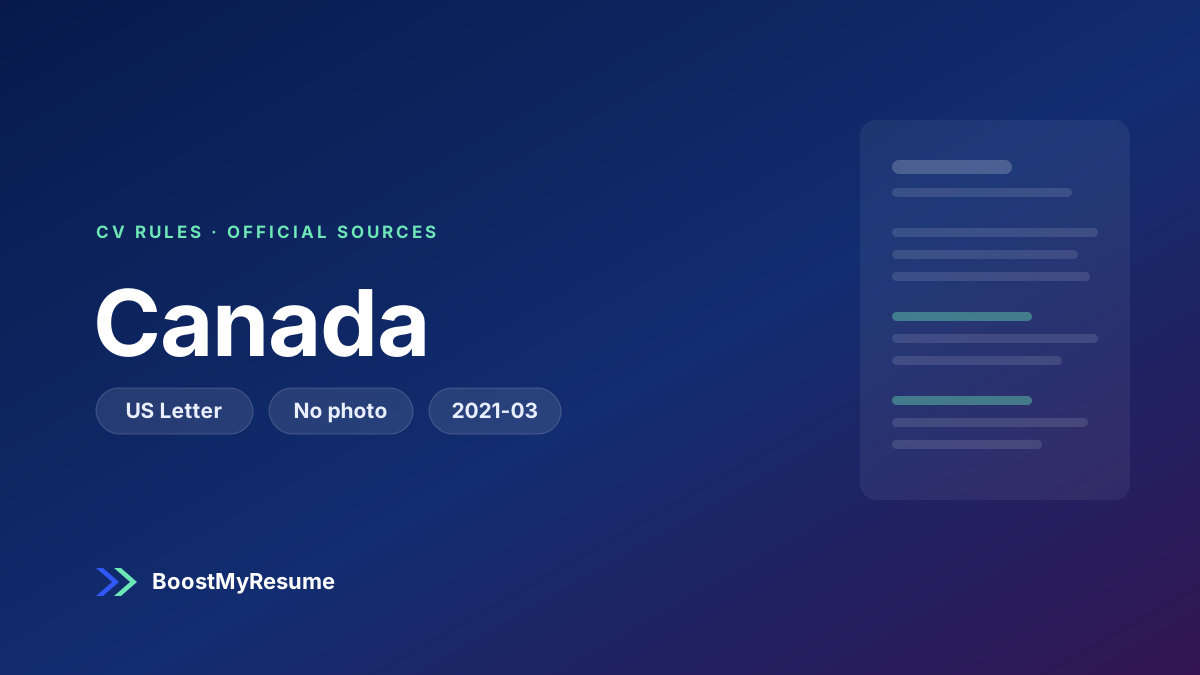
For a Canadian resume, use Letter paper, omit the photo and date of birth, never include your Social Insurance Number, and write in the language of the vacancy. Spell out months or use an unambiguous ISO date format.
Write 07/01/2026 and a French-Canadian reader sees January 7 while an English-Canadian reader sees July 1. The format is North American, but the country is officially bilingual, so the document must hold up in both languages. The wider comparison across eleven markets is in our resume format by country guide.
The rules in brief
- Photo: no.
- Date of birth, age: omit.
- SIN: never on a resume - the Job Bank warns against it explicitly.
- Length: 1–2 pages.
- Page size: US Letter.
- Language: match the vacancy - English or French.
- Dates:
Mar 2021 – Presentin English,mars 2021 – aujourd'huiin French,2021-03as the bilingual-safe form. - File:
Jordan_Avery_CV_CA_EN.pdforJordan_Avery_CV_CA_FR.pdf.
Photo and personal data
Canada follows the North American pattern: no photo, no date of birth, no age. As in the US, age-related information invites discrimination concerns, and a Canadian recruiter has no use for a headshot. If your master document was built for a European market that expects a photo, remove it before anything crosses the Atlantic - and remove the personal block with it. City and province are enough for location.
Canada then adds a warning of its own, and it is the strongest one in this cluster: never put a Social Insurance Number on a resume. The Government of Canada's Job Bank says so explicitly in its safety guidance for job seekers. The SIN has no business at the application stage - no legitimate employer needs it to screen you, and a resume is a file you email, upload and lose track of. The same instinct covers everything in its category: no ID numbers, no bank details, nothing a fraudster could use.
Nationality: your choice
Job Bank recommends leaving unnecessary personal details off a resume. Following that approach, our default is to omit nationality; that is a privacy recommendation, not a claim that Canadian law bans the field.
In the editor, nationality is optional in every document language. A supplied value, including dual nationality, stays saved; you choose whether it appears on the CV. Hiding it does not erase it, and changing language or target market does not change that choice. Nationality, country of residence and work authorisation are separate facts.
The bilingual reality: match the vacancy
Canada's two official languages are not decoration on this topic - they decide which document you send. The working rule is simple: the vacancy's language picks the resume's language. An English posting gets an English resume. A Québec posting written in French gets a French CV, with French section headings, French date words and French wording throughout - not an English resume with a translated summary bolted on.
Practically, that means bilingual candidates maintain one career profile and produce two documents from it. The facts stay identical; the headings, dates and phrasing switch:
| Language | Standard headings |
|---|---|
| English | Contact details · Professional summary · Work experience · Education · Skills · Languages · Certifications · References |
| Français | Coordonnées · Profil professionnel · Expérience professionnelle · Formation · Compétences · Langues · Certifications · Références |
This is exactly the case our builder is built for: keep one profile, switch the target between English Canada and French Canada, and the headings follow the language you picked.
Dates: why Canada recommends ISO
Back to 07/01/2026. English-Canadian habit reads all-numeric dates one way, French-Canadian habit the other, which is why the Government of Canada recommends the ISO form YYYY-MM-DD - 2026-01-07 - as the only all-numeric date style that means the same thing in both official languages.
On a resume, that translates into three safe options:
- English resume:
Mar 2021 – Present. Spelled months are unambiguous. - French resume:
mars 2021 – aujourd'hui. Same logic, French words - including the translation of "Present." - Bilingual-safe numeric:
2021-03, the year-month slice of the ISO recommendation. Useful when you want numerics that no reader in either language can misparse.
Whichever you choose, keep one convention through the whole document, on the same line as each role. Mixing Mar 2021 in one entry with 03/2021 in the next is a small thing that reads as carelessness in any language.
Length, page size and the file name
Length is the familiar North American 1–2 pages: one page early in a career, two when the experience genuinely fills them.
Page size is US Letter, like the US and unlike every European market. An A4 export will not reject your application, but it reformats margins and page breaks when printed - export for the paper the country actually uses.
File name: Jordan_Avery_CV_CA_EN.pdf for the English document, Jordan_Avery_CV_CA_FR.pdf for the French one. Plain ASCII, underscores, and a language tag that tells the recruiter which version they are holding before they open it.
Cover letter and references
The language-matching rule extends to everything you send: if the vacancy is in French, the cover letter is in French too, not just the resume. Beyond that, follow the posting - when it asks for a letter, send a tailored one; when the process requests references, provide them as a separate document rather than spending resume lines on them. The vacancy and the application form always override the general rule.
ATS notes for the Canadian market
Canadian employers screen with the same applicant tracking systems as their US counterparts, so the machine-readability baseline applies unchanged - in both languages:
- One text column, standard headings (English or French, from the table above), normal reading order.
- Name, phone, email, city and links in the document body, not only in a header or footer.
- Selectable text; no scanned pages, no graphics standing in for skills, no layout tables.
- A text-based PDF unless the portal explicitly asks for DOCX.
A French-language resume for a Québec employer needs the same ATS hygiene as an English one - the parser does not care which official language it is reading, only whether it can read it. The full checklist is in our ATS optimization guide.
Canadian quirks worth knowing
- The SIN rule has no exceptions at the resume stage. The number belongs in onboarding paperwork after you are hired, never in an application document.
- "Resume" and "CV" coexist. English Canada says resume; French Canada says CV. Unlike in the US, neither word will confuse anyone - but the file-name tag (
_CA_EN/_CA_FR) should still match the language inside. - ISO dates are an official recommendation, not folklore.
2026-01-07is the Government of Canada's answer to its own bilingual ambiguity problem - which makes2021-03 – Presentthe rare numeric date range that is actually safer in Canada than spelled months are. - A US resume is close but not finished. The Letter page, missing photo and omitted birth date carry over directly - see our US resume format guide for that rule set - but the SIN warning, the language matching and the date recommendation are Canada's own.
Sources
- Job Bank - How to write a good résumé (Government of Canada)
- Job Bank - Safety tips for job seekers (Government of Canada)
Common questions
Do I need a photo on a Canadian resume?
No. Canada follows the North American pattern - no photo, no date of birth, no age. Let the work experience carry the application.
Should my SIN go on my resume?
Never. The Government of Canada's Job Bank warns explicitly against putting a Social Insurance Number on a resume. No legitimate employer needs it at the application stage, and a resume circulates far beyond your control.
Should my Canadian resume be in English or French?
Match the vacancy. An English posting gets an English resume; a Québec French posting gets a French CV. Keep one career profile and produce both versions from it rather than sending one language everywhere.
What date format should a Canadian resume use?
Mar 2021 – Present in English, mars 2021 – aujourd'hui in French, or the bilingual-safe 2021-03. The Government of Canada recommends the ISO form YYYY-MM-DD as the only all-numeric date style that reads the same in both official languages.
Is A4 okay for a Canadian resume?
Use US Letter. Canada prints on the North American page size; an A4 file will not reject your application, but it reformats margins and page breaks when printed. Export for Letter.
How long should a Canadian resume be?
One to two pages. As in the US, one page is normal early in a career and two pages are fine when the experience genuinely fills them.