France CV format: rules for the French CV, explained for expats
Two A4 pages, no photo by default, a profil line that earns its space and a lettre de motivation: the French CV format explained for English speakers.
The first decision about a CV for France is not the layout - it is the language. A French employer normally reads a French CV, and an English speaker applying in Paris or Lyon should plan for that before polishing anything else. Once the language is settled, the format itself is one of Europe's leaner ones: two A4 pages at most, no photo by default, and a personal-data block that official guidance now treats as entirely optional. This guide covers the full rule set for France; for how it compares with ten other markets, start from our resume format by country guide.
The rules in brief
- Language: French by default; English only when the vacancy or employer works in English.
- Photo: off by default; add one only if the vacancy or sector genuinely expects it.
- Date of birth, age, marital status, nationality: optional - omit unless you have a reason.
- Length: maximum 2 pages.
- Page size: A4.
- Dates:
03/2021 – 06/2024French numeric style, or spelled-out months. - Cover letter: the lettre de motivation is still expected in many processes.
- File:
Jordan_Avery_CV_FR_FR.pdf.
Write it in French - and know when English works
For most vacancies in France, the CV is written in French, full stop. That holds even when your career happened entirely in English: translate the substance, not the sentences, and keep job titles that only exist in English (a "Product Manager" stays a Product Manager) where a forced translation would confuse.
The exceptions are real but narrow. International companies with English as a working language, vacancies posted in English, and roles where the team itself is anglophone will happily read an English CV - usually on A4 with European conventions, which is a different document from a US resume. If the posting is in French, the CV should be too. And if French is not your strongest language, have the final text checked by a native reader; a CV with grammatical errors in French does more damage than an honest B2 level declared in the languages section. Our guide on writing a resume in another language covers the translate-the-career principle in depth.
Photo and personal data: lean by design
French official guidance keeps the CV lean. Our recommendation is to omit personal details you do not need to share, along with the photo, and let the experience section carry the application. No law forbids a photo in France, but nothing in the screening needs one, and the photo-free version is the safer default for both privacy and parsing.
For location, city and country are enough. If an application asks about work authorisation, answer with your actual situation in the requested field. Do not use nationality as a substitute for that answer.
Nationality: your choice
EURES France calls nationality optional for EEA nationals. That wording does not establish a CV requirement for everyone else. Our recommendation is to omit it unless you have a specific reason to share it.
In the editor, nationality is optional in every document language. A supplied value, including dual nationality, stays saved; you choose whether it appears on the CV. Hiding it does not erase it, and changing language or target market does not change that choice. Nationality, country of residence and work authorisation are separate facts.
Structure and the profil line
The skeleton is reverse-chronological and familiar: contact details, a short profile, experience, education, skills, languages. What France reads with unusual care is the profil line at the top - two to four lines targeting the specific role. Recruiters in France read it, and a generic one wastes the best real estate on the page. Write it for the vacancy, not for your career in general.
The headings a French recruiter expects:
| Language | Standard headings |
|---|---|
| Français | Coordonnées · Profil professionnel · Expérience professionnelle · Formation · Compétences · Langues · Certifications · Références |
For an English speaker, the Formation heading is the classic false friend - it means education and training, not corporate training courses. And the languages section matters more for you than for a local candidate: state your French level honestly using CEFR levels, because it will be tested within minutes of a first call.
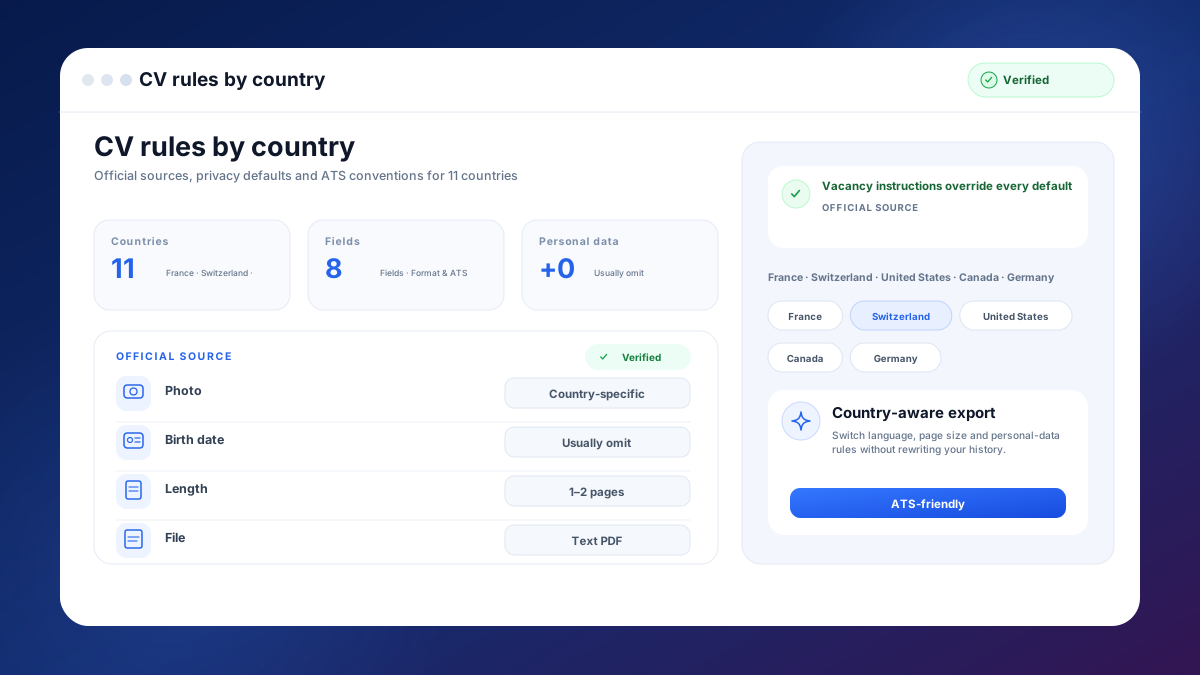
Length, page, dates and the file name
Two pages, maximum. French guidance is consistent on the cap. One page is common early in a career; two pages are normal once the experience justifies them.
A4, not Letter. France prints on A4. A US Letter export quietly signals a document prepared for another market and reformats the moment it meets a French printer.
Dates, French style. On the CV, use 03/2021 – 06/2024 or spelled-out months such as mars 2021 – juin 2024. French numeric order is day-first - 14/03/2026 - so never import US month-first numbers, where 03/04/2025 means March 4 to an American reader and April 3 to a French one. For a current role, write aujourd'hui, not "Present," on a French-language CV.
File name. Jordan_Avery_CV_FR_FR.pdf - ASCII characters, underscores, no accents in the file name even though the document itself is full of them.
The lettre de motivation
France is one of the markets where the cover letter still carries real weight. The lettre de motivation is a live tradition: add a tailored one whenever the vacancy mentions it, and expect many processes - especially in traditional sectors and the public sphere - to treat it as a standard part of the application. Like the CV, it is normally written in French. A short, specific letter that names the company and the role beats a page of generalities; our cover letter structure guide covers the mechanics.
ATS notes for the French market
French employers screen at volume like everyone else, so the machine-readability baseline applies in full:
- One text column, standard headings from the table above, normal reading order.
- Name, phone, email, city and links in the document body, not only in a header or footer.
- Selectable text; no scanned pages, no skill-rating graphics, no tables as layout.
- A text-based PDF unless the portal asks for DOCX.
- One date convention throughout, on the same line as each role.
Accented characters in the text are fine - modern parsers handle French without trouble - but keep them out of the file name. The full mechanics are in our ATS optimization guide.
French quirks worth knowing
- The profil is not decoration. French recruiters read the top block carefully. Two to four lines, targeted to the role, earn their space; a generic objective does not.
- Diplomas matter. French hiring culture gives education real weight, including mid-career. Name the degree and the institution; if your qualification is foreign, give its French equivalent or level where one exists.
- Nothing is legally mandated. No CV template is required for private-sector applications in France. The vacancy and the employer's instructions always override the default.
- Public-sector applications play by their own forms. Concours and public-body processes have structured requirements of their own; when a form asks for something specific, the form wins.
Sources
Common questions
Should my CV for France be in French or English?
French, by default. A CV for a French employer is normally written in French, and sending an English document to a French-speaking hiring process is a real handicap. An English CV is viable when the vacancy is posted in English or the employer is an international company that works in English - let the language of the job posting decide.
Do I need a photo on a French CV?
No. The photo is off by default in France. It is not banned, but it adds nothing to the screening and the privacy-first version is the safer document. Add one only if the vacancy or the sector genuinely expects it.
How long should a French CV be?
Two A4 pages at most. French official guidance keeps the CV lean - if the content does not fit in two pages, cut the oldest and least relevant material rather than shrinking the font.
Should I put my date of birth on a French CV?
It is optional, and the safe default is to leave it off. Our recommendation is to omit personal details you do not need to share. Nationality is a separate choice, discussed below.
Do I need a cover letter for a job in France?
Very often, yes. The lettre de motivation is still a live tradition in France. Add a tailored one whenever the vacancy mentions it, and treat it as part of the application rather than an optional extra.