Does an Employer Have to Tell You AI Screens Your Resume?
Sometimes. AI hiring disclosure depends on your location, the employer and how the tool affects the decision. Compare current NYC, Ontario, UK and US rules.
An employer has to tell you about AI resume screening only in some situations. The answer depends on the jurisdiction, the employer's size, the type of tool and whether automation merely assists a person or makes a significant decision without real human involvement. New York City and Ontario have explicit notice rules; UK data-protection rights can apply to solely automated significant decisions; the United States has no blanket federal AI-screening notice law.
This guide gives a practical map as of August 15, 2026. It is general information, not legal advice, and a local rule may define “AI,” “automated decision” or “employer” more narrowly than everyday language does.
The current answer at a glance
| Location | When notice may be required | What the rule does not automatically mean |
|---|---|---|
| New York City | Before an employer or employment agency uses a covered automated employment decision tool | Every ATS or keyword search is covered, or an alternative process must be offered |
| Ontario | In a public job posting when a covered employer with at least 25 employees uses AI to screen, assess or select applicants | The posting must explain the model, score or detailed logic |
| United Kingdom | When a significant decision is made solely by automated means, data-protection rights can include notice, challenge and human review | Any software assistance makes the entire hiring process solely automated |
| United States federal baseline | No general nationwide AI-screening notice rule, but anti-discrimination and accommodation duties still apply | Lack of a special AI notice removes existing civil-rights protections |
The table is a starting point. The definitions and exceptions determine whether a rule covers a particular application.
First, separate ATS from AI screening
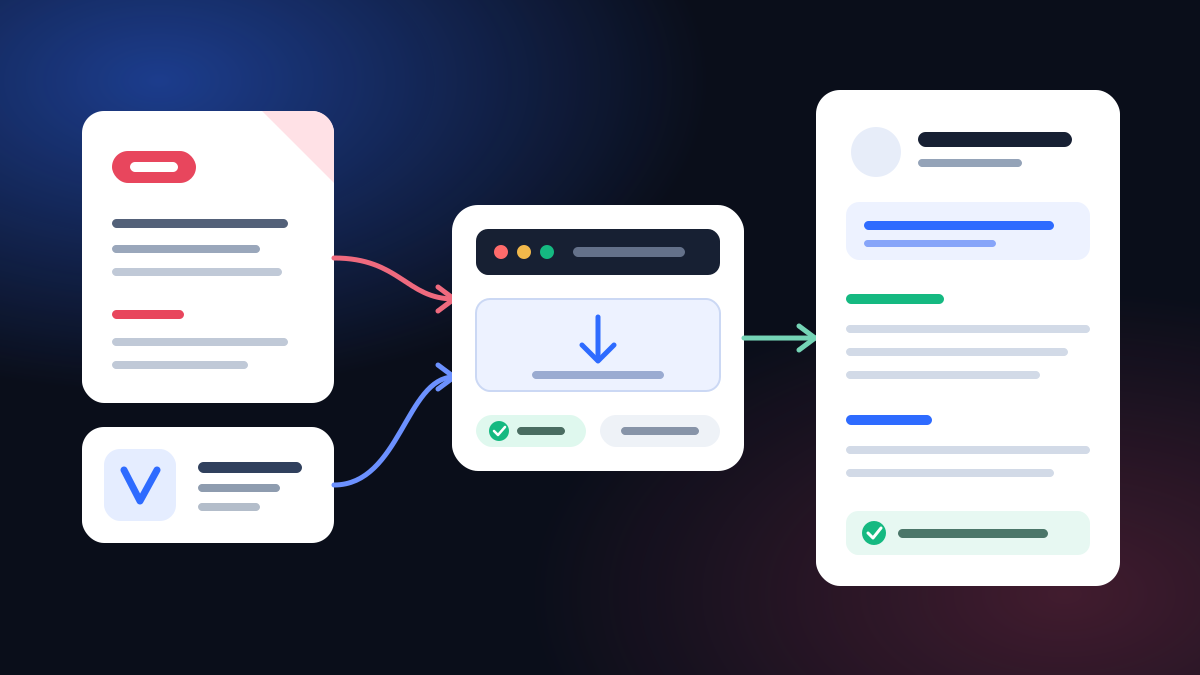
An applicant tracking system can receive files, store candidate records, extract names and dates, and help recruiters organize applications. Those administrative functions do not necessarily make a hiring decision.
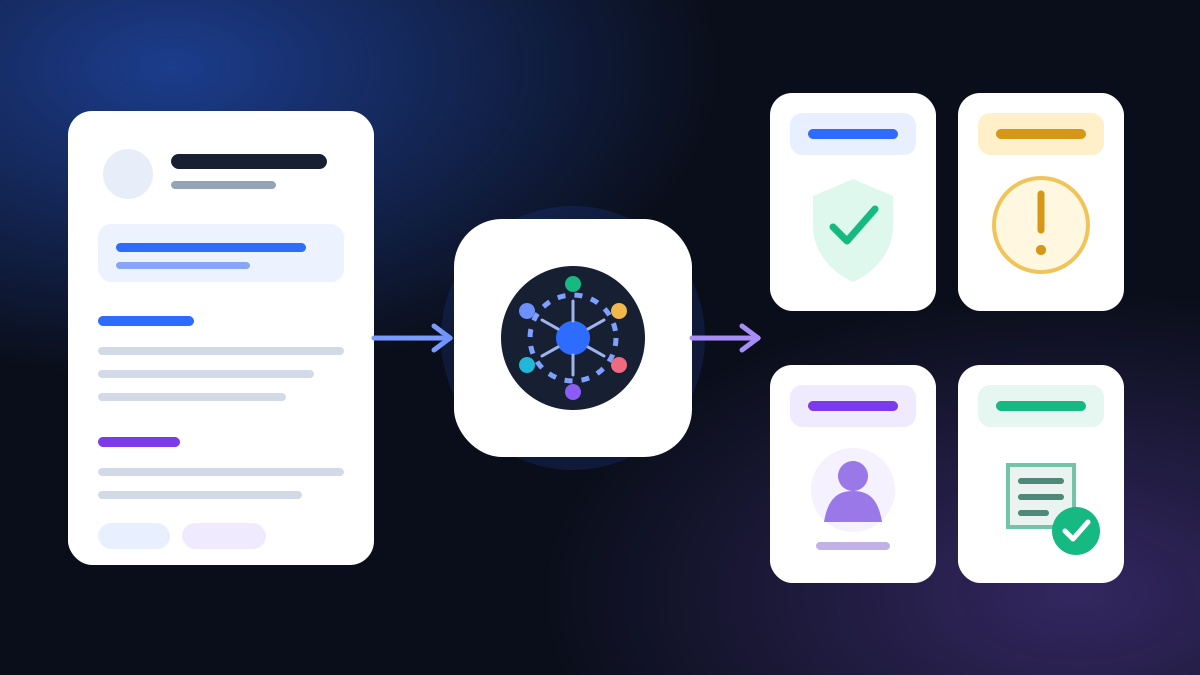
AI or automated screening may go further by analyzing, scoring, ranking, filtering or recommending candidates. Even then, the legal question may turn on whether the tool is covered by a specific definition and whether a person meaningfully reviews the result.
That distinction matters for your expectations:
- a parsed resume does not prove that an algorithm rejected you;
- an automated score does not always mean the final decision was solely automated;
- a human clicking “reject” does not necessarily create meaningful human review if the person simply follows the score;
- a disclosure that AI is used does not tell you that the tool is accurate, fair or decisive.
For the technical side of extraction, see how an ATS reads a resume. For the separate question of authorship detection, read whether recruiters can detect an AI-assisted resume. Neither question answers whether the employer complied with a local disclosure rule.
New York City: advance notice for covered tools
New York City's Department of Consumer and Worker Protection says Local Law 144 prohibits employers and employment agencies from using a covered automated employment decision tool unless:
- the tool has had a bias audit within one year of use;
- information about the audit is publicly available;
- required notices have been provided to candidates or employees.
The department states that notice must be provided 10 business days before use of the tool. The notice framework also identifies the job qualifications and characteristics the tool will assess.
This does not mean every database search or automated feature is covered. The city uses a legal definition of an automated employment decision tool. Whether a tool falls inside it can depend on how it assists or replaces discretionary decision-making.
A candidate can request an alternative selection process or accommodation. The city's rules do not require the employer to provide an alternative process merely because it was requested. An accommodation right may still come from another law, including disability law.
If the rule appears to apply and no notice was given, the department provides a public complaint route from its official AEDT page.
Ontario: the job posting must say whether AI is used
Ontario's official guide to publicly advertised job postings states that, from January 1, 2026, an employer that publicly advertises a job and has 25 or more employees on the relevant date must include a statement disclosing whether it uses artificial intelligence to screen, assess or select applicants for the position.
The requirement can also apply when a third party publishes the posting for the employer. The guide lists exclusions, including employers below the employee threshold and certain public-sector employers covered by separate exclusions.
Ontario requires a yes-or-no disclosure in the public posting. The guide says the employer does not have to provide details about how AI is used. Therefore:
- “We use AI to screen applicants” may satisfy the disclosure element without naming the system;
- no statement can be meaningful if the employer is covered and AI is used for the listed purposes;
- a statement does not reveal the score, model logic, data fields or weight given to the tool.
The precise legal text is in Ontario Regulation 476/24. Save a copy or screenshot of the posting when you apply, because the text may change later.
United Kingdom: focus on solely automated significant decisions
The UK Information Commissioner's Office explains that automated recruitment tools can analyze, score, rank or filter applications. In its 2026 guidance for jobseekers, the ICO says that when a decision is made without a real person involved, jobseekers have rights to know automated decision-making was used, challenge the decision and ask for human review.
The boundary is important. A recruiter using a tool as one input is not automatically the same as a significant decision made solely by automated means. The quality of the human involvement matters: a person should do more than approve the system's result without examining it.
The ICO's broader public guidance on decisions made without human involvement explains the rights and also notes that its guidance is being reviewed following changes in UK data law. That is a reason to check the current official page when a real decision matters, not to assume an old summary remains exact.
The ICO has also reported privacy and fairness problems in recruitment tools. Its 2024 audit intervention produced almost 300 recommendations to providers, including recommendations concerning protected-characteristic filtering, inferred data and clearer privacy information. This shows why notice and meaningful review matter, but it does not prove that every tool or employer has the same defect.
United States: no blanket federal notice, but existing rights remain
At federal level, there is no general rule requiring every US employer to tell every applicant whenever AI touches a resume. State and local laws can add duties, as New York City's example shows.
Existing anti-discrimination law still applies to technology. The US Equal Employment Opportunity Commission and Department of Justice warn that algorithmic hiring tools can unlawfully screen out people with disabilities and that employers should have a process for reasonable accommodations.
This matters when, for example, an assessment measures a disability-related limitation instead of the skill required for the job. You do not need to diagnose the algorithm before asking for an accommodation. Explain the barrier and the change you need to participate fairly in the application process.
Federal protections do not create a universal right to receive the model's full source code, training data or score. They do mean that using software does not excuse disability discrimination.
How to check your own application
1. Save the job posting
Keep a PDF or screenshot showing the date, location, employer, AI statement and application instructions. A posting can be edited or removed after you apply.
2. Read the privacy notice and candidate portal
Search for plain terms and legal terms:
- artificial intelligence or AI;
- automated decision-making;
- algorithmic assessment;
- screening, scoring, ranking or matching;
- profiling;
- human review;
- accommodation or alternative process.
Do not assume that “we use technology” explains what influenced the decision. Also do not assume silence proves that no automated tool was used.
3. Ask a narrow question
A focused question is easier to answer than “Did AI reject me?” Try:
Was an automated tool used to score, rank, filter or make a recommendation on my application? If so, what role did it play, and was the result meaningfully reviewed by a person?
If a disability creates a barrier, ask separately for the accommodation you need. You can make that request without waiting for a technical explanation.
4. Request review using the right local language
In the UK, focus on whether a significant decision was made solely by automated means and request human review. In New York City, ask whether a covered AEDT was used and refer to the required notice. In Ontario, compare the public posting with the employer-size threshold and the stated use of AI.
5. Keep the evidence and use the official channel
Save the posting, notice, emails, assessment instructions and your request. If you make a complaint, use the regulator or public authority responsible for the rule. Do not send your full resume or sensitive medical information unless the channel requires it and you understand how it will be handled.
What an AI notice cannot tell you
Even a compliant notice leaves important questions open:
- Did the tool merely organize applications or materially rank them?
- Which resume fields were analyzed?
- Did a person review the result before rejection?
- Could an accommodation or correction change the outcome?
- Was the tool tested for the relevant group and use case?
Those questions explain why a disclosure is a starting point, not proof that the process was lawful or unlawful.
They also explain why you should not contort a resume to “beat AI.” Keep the document truthful and machine-readable. A clean file reduces accidental extraction problems; it cannot waive your rights or guarantee a hiring outcome.
Applicant checklist
- I saved the original posting and its AI disclosure, if any.
- I identified the job location and the employer named in the posting.
- I read the privacy notice, assessment instructions and follow-up emails.
- I asked what the tool did and whether a person meaningfully reviewed the result.
- I requested an accommodation if a disability created a barrier.
- I kept the response and used an official regulator channel if follow-up was necessary.
- I checked current official guidance instead of relying on a generic worldwide summary.
Official public sources
- New York City Department of Consumer and Worker Protection - Automated Employment Decision Tools
- Ontario - Requirements related to publicly advertised job postings
- Ontario Regulation 476/24
- UK Information Commissioner's Office - What jobseekers need to know about automated recruitment decisions
- UK Information Commissioner's Office - Decisions made without human involvement
- UK Information Commissioner's Office - AI recruitment audit intervention
- US Equal Employment Opportunity Commission and Department of Justice - Disability discrimination and AI hiring tools
So, does an employer have to tell you? Sometimes, under a rule tied to your location and the actual use of the tool. Start with the posting and official local guidance, distinguish ordinary ATS processing from automated decision-making, and ask for human review or an accommodation where the applicable rule gives you that route.
Common questions
Does an employer have to disclose AI resume screening?
Sometimes. New York City requires notice before a covered automated employment decision tool is used, and Ontario requires certain large employers to state in public job postings whether AI is used to screen, assess or select applicants. UK rights can apply to significant decisions made solely by automated means. There is no single worldwide disclosure rule.
How can I tell whether AI screened my resume?
Check the job posting, application privacy notice, candidate portal and follow-up emails for terms such as automated decision, artificial intelligence, algorithmic assessment, ranking or screening. You can also ask the employer which tools materially influenced the decision, but the answer and disclosure duty depend on local law.
Can I request a human review of an automated hiring decision?
That depends on the jurisdiction and the decision. UK data-protection guidance describes rights to know, challenge and ask for human review when a significant decision is made without real human involvement. A New York City candidate may request an alternative selection process or accommodation, but the city rule does not guarantee that an alternative will be offered.
What if an AI hiring tool disadvantages my disability?
In the United States, federal disability-discrimination protections can require a reasonable-accommodation process even without a blanket AI disclosure law. Tell the employer that you need an accommodation for the assessment or application process and focus on the barrier, not on proving which software caused it.
Is an ATS the same as AI resume screening?
No. An applicant tracking system can simply store applications and extract fields. AI screening involves automated analysis, scoring, ranking, filtering or recommendations. A system may do both, but uploading a resume to an ATS does not by itself prove that AI made or substantially influenced a hiring decision.